when the consensus doesn’t hold

Good video by Morgoth:

It seems human nature to observe and then follow the consensus. Women, especially, are tribal conformist creatures, as multiple studies and the experience of the ages have demonstrated. I’ve lost track of how many German cows I’ve seen with a dreadful Louis Vuitton bag on the train:

– women especially don’t acquire things because of any inherent value, but because women like Meghan Markle have one, and they want to be just like her. It is natural, then, that the Government would create a “we fear reprisals against the Muslim community!” narrative; because if the NPCs see it on TV, they will parrot “the worst thing about this Truck of Peace attack is that innocent Muslims will certainly be targeted by the far-right. Nigel Farage, who is a racist, is probably stabbing innocent Muslim babies.”

It is effective. However, since it is not even remotely true, the natural human tendency to notice patterns (e.g. that most crime is committed by dark-skinned immigrants or children thereof) will lead to a certain cognitive dissonance. When a NPC begins to question the fabricated consensus, because it is so unified & internally coherent, it will collapse all at once in his mind. And then he will most likely go to the other extreme.

“popular with old people”

The Z Man

Just as killing off Christianity was never going to kill off religion – people will believe in something – killing off national identity is not going to kill off identity. The decimation of mainstream Christianity has resulted in a fragmentation of the religious space, with all sorts of beliefs rushing in to fill the void. The decline of national identity and the subsequent war on white people is creating room for tribalism to flourish. In this regard, civic nationalism is a rearguard action. It’s why it is popular with old people.

I’ve recently encountered several real life examples of the Boomer meme. There is something rather special about Western Europeans, especially German women, who grew up in peace & prosperity, told that their parents & grandparents were monsters and the Jews are sacred angels – they inhabit a kind of blissful utopia of the mind, where we can all get along provided we disown our ancestors and our traditions and put white people at the bottom of the entire universe.

One of their favourite arguments for the ghastly EU is that if we don’t have a totalitarian superstate controlling everyone on the planet, we’ll go back to the 1930s and have nations fighting wars because that is what nations do. It is true that nations in the USSR didn’t wage war on each other; wars were rather conducted by the centre against recalcitrant appendages such as Hungary in 1956. So, a totalitarian superstate would, in a sense, be preferable to a world of competing nations.

There is some truth here. As long as you have distinct groups, they will fight & compete, much as children naturally squabble. My response would be: competition, even to the point of war, is inevitable, and totalitarian attempts to quash dissent are not preferable to an intelligent, nuanced working-out of grievance and strife. And if you want to say nations lead to war and therefore we should have no nations, you could also say the Mafia is founded on family and therefore we should have no family, or that fruits can become alcohol and alcohol can kill people, so we should therefore eradicate fruit.

But it is very much a generational malaise. The younger generations, who will grow up with racial conflict and daily violence, will regard the Boomers with amazed disdain and contempt.

the modern academic

The Z Man:

It used to be that an intellectual mastered a subject in order to build on it. The point of his labor was not to prove he had read everyone in the field. The point was to find the gaps in his field and use the source material as a foundation for filling some of those gaps. In other words, the academic added to his field, rather than maintained it like a curator of a museum.

This shift from speculation to memorization reflects the shift in the culture, not just the education system. As a managerial system came to dominate the upper reaches of society, the education system became an exam system. You pass through the system in order to accumulate credentials that open doors within the managerial elite. The system began to select against people who question the current order. Instead, the system selects for those most likely to support and defend the system.

There is also the question of what to memorize. It is one thing to have a folder full of citations (c.f. Fowler et al. p344-6) to brandish like a porcupine’s quills or peacock’s tail; it is another to have a well-stocked memory of Western literature. At my (reputable) alma mater I found academics oddly uninterested in anything that couldn’t be ground into mincemeat for their latest research paper; and given the nature of academic publishing, that meant their interests were exceedingly narrow. One of my tutors specialised in modernism & post-modernism and hadn’t read Chaucer; another specialised in Milton and hadn’t read Dante.

The modern academic is a special form of ignoramus, stuffed with largely useless knowledge (e.g. the last decade of “research” into his topic). He cannot discern; cannot order; cannot think. To know what to memorise and why, to be able to transform information into knowledge, is to be old-fashioned, aberrant.

after the ruins

Until about 2015 I felt that Western civilisation would inevitably collapse, over about two to three generations, and if one could go forwards to 2050-or-so, everything from California to Berlin would look like Mogadishu. But to quote Hölderlin:

Wo aber Gefahr ist, wächst

Das Rettende auch

(salvation flourishes where there is danger, my loose translation)

So, as the globohomo, through Merkel et al. decided to terminate Western civilisation in a short time frame, reality itself responded in the form of e.g. The God Emperor, blessings be upon him.

Q and Trump have both signalled that the Cabal’s takeover of America (and the world) cannot be allowed to happen again. Since it seems the Storm is even now breaking, it is worth thinking, How could one Cabal-proof any system?

I can think of two useful means:

1. Foster what Anonymous Conservative calls “the myth”: of patriotism, public service, integrity.

If people think of the FBI as full of Agent Dale Coopers and Gordon Coles – upright, incorruptible men of law & order – then most recruits should be attracted to such ideals. While there will always be psychopaths and bullies, and the merely weak and corruptible, if most recruits are initially believers in “the myth”, the organisation will most likely retain a subterranean possibility of goodness, in spite of corruption.

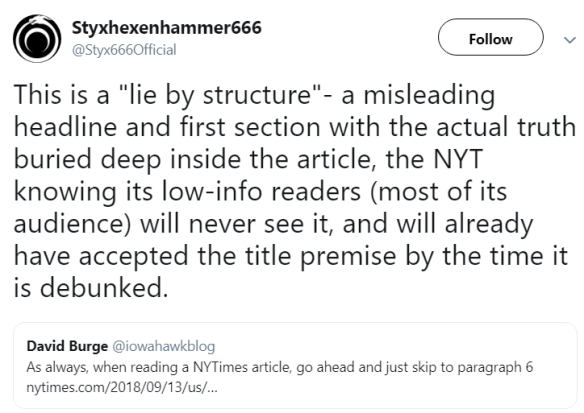
2. Teach all schoolchildren how to analyse the news. At my school, aged 12 or so, we had an English class where we compared newspaper articles discussing the same event. The teacher drew attention to the vocabulary, so e.g. one might use “protestors” and the other “angry mob”. At a higher level one could point to what Styxhexenhammer calls “lie by structure”:

Although I was bottom of my class at school, this lesson stuck. I learnt to ask “from where does this report come?” and to look for equivocative and weasely language, for evident rhetoric, unsupported assertions, for contradictions – for basically everything you find in chaimstream media. I learnt to “delouse” as Leary puts it in In The Line of Fire.

This should be taught weekly from, let’s say, age 12. Let the young learn a healthy contempt for journalists.

the Matcha Martini

I accidentally created my own cocktail this week: a standard(ish) Martini, stirred through with a pinch of matcha powder.

The proportions are:

4 cl gin

about 0.5-1.0 cl Dry Vermouth (I prefer just a dash of Vermouth)

and then, with a chashaku

stir in a pinch of matcha powder, stirring vigorously for about ten seconds. Then add ice.

The result will look a bit like absinthe, and the taste is milder, creamier, but with enough bite and astringency to make for an interesting evening drink.

film report: The Last Samurai

A good, almost great, film. The opening, with Cruise’s Nathan Algren as an alcoholic soldier trotted out on stage to sell Winchester rifles with tales of derring-do (actually, slaughtering villages of Amerigooks), is superb; and I greatly enjoyed the middle section, with Algren captured and slowly civilized by the samurai. The last section, the giant battle and closing, falls flat for me – it’s technically very well done but a little unimaginative, predictable.

All of the acting is splendid. Ken Watanabe is particularly good, bearing a Chow Yun-Fat esque charisma and bald head and lengthy sword.

The film was successful, interesting as it romanticises tradition and masculinity and the warrior code – all the things despised and reviled by the chaimstream media and Hollywood and our rulers. I especially enjoyed the respect for death, the sense that a good death makes for a good life.

the society of the lie

The Z Man:

There was never a time when news reporters were objective or conformed to a set of ethics. In fact, the idea of journalistic ethics is an entirely new thing. The reporters in the 1920’s would have laughed themselves silly if someone scolded them about their ethics. The newspaper man was a carouser who lived rough and played rough. Until after World War II, being in the media was a working class job with the morality of carny folk.

My father tried to force me to read the dreary Times every day, “well egh to build up the vocabulary egh!” as he put it. I leafed disconsolately through this garbage every morning, praying for an earthquake or war to liven things up a bit. At the time, I thought I was totally uninterested in politics and so-called current events, and stuck to Henry James and Nietzsche.

Only in 2006 or so, I found writers like Theodore Dalrymple and Roger Scruton, who made some sense of England’s degenerate culture. And only in 2015, with the Ascent of the God Emperor, did I pay any attention to daily happenings.

I now realise that mainstream media isn’t news as such; it is commentary, spin, on the daily events, and one requires extreme caution to factor in the bias and deceit. I have met several journalists, some very high level, and found them to be astonishingly ignorant and often surprisingly unqualified. For example, I met the politics editor of a major European “intellectual” newspaper in summer 2016; he was planning a trip to the US to liaise with the Washington Post and New York Times: he had never heard of “the Alt-Right” or Stephen Bannon.

Most people will say politicians are all liars, but quite a few people still seem to trust mainstream journalism, despite many cases of outright knowing falsehood. We live in a society of the lie, and the nobility & integrity of journalism is one of the subtle little lies by which we are fed the whoppers.

Even a fairly based show like Person of Interest has an episode about a valiant and wonderful female journalist who is threatened because of her fearless exposés. In reality, she would be a corporate lackey, Left-wing, who would simply take orders to attack Western civilisation, and to cover up any Democrat/Left-wing crimes; if she got too close to a juicy story, her editors would tell her to back off. Curiously, as if reality asserts itself in spite of the narrative, she looks and acts like a slimy, opportunistic snake, with an expression of constant smug superiority:

People will accept the fundamentally Darwinian nature of society, that e.g. Google wants to be the only major search engine, that McDonald’s would be quite happy for Burger King to go bankrupt, and yet these same people don’t for a moment think the powers that be would infiltrate, subvert, and control mainstream media. Means, motive, opportunity – all three are present, and yet if you so much as suggest it, or mention Operation Mockingbird, the NPCs titter about conspiracy theories.

But then, most people are fairly honest and lack both the cognitive powers and the sociopathic detachment to conspire at length. Hence, most people cannot be journalists.
inspirational quotes

From the splendidly-titled Lost All Hope, a little treatise on suicide, specifically by jumping from a high place:

“Ideally, anyone jumping on land should try and land on their head”

“It should go without saying that great care should be taken when jumping to not land on any person, or anything that might break the fall.”

I can’t imagine anyone writing that without a little smile.