A pleasing, light-hearted film. It’s hard to find comedies that make this old dog so much as smile, let alone laugh. Spy, a satire on, well, spy films, is directed by Paul Feig, who was responsible for the feminist abortion that was 2016’s “woke” Ghostbusters. Watching Spy in this light, it is easy to see the feminist agenda, though it is pleasingly free of paedophilia, Satanism, anti-Trump rants, and heroic black men who make great fathers and are just so much wiser and better than the White Devil.
I enjoyed the film enormously. The central character, a fat bumbling but somehow lethally-effective CIA desk agent, is amusing and unthreatening. I imagine, were the film made a couple of years later, she would have gone off on anti-Trump rants every 30 seconds, but this was a more innocent age and so she is a kind of box wine cat lady auntie. The film is so nourishing for those in a bleak situation because of the love of character – every character is lovable, fun, my favourites being the Italian agent Aldo
and the Statham-esque Jason Statham.
Curiously, both characters are in a sense playing themselves – Aldo is the Italian cliche, loud, lecherous, fast, but as I was watching the film I thought “Italians are actually like this”. As Geoff Dyer wrote, somewhere, the favourite Italian pastime is to act like an Italian. And Statham is somehow both over the top and precisely himself – almost every Statham film features the man as the hard-headed, omni-competent, profane Sarf London brawler (though he’s actually from the Norf):
I’ve always liked Statham. His performances are so reliably insane
that I felt he must be smiling at himself and his image throughout. He has that very English intelligence, which learns to mask itself – in his case, his mask is Jason Statham. He excels here, my favourite being the scene where he appears in a rather nice suit and Melissa McCarthy’s cat lady says ” where did you get that suit?” and he snaps back: “I fucking made it, didn’t I?”
And so, you can have a film written & directed by someone who looks like this:
which is actually enjoyable for old dog fascists, somehow.
In my youth, every bodily twinge or anomaly could alarm me to the point of seeking out a doctor. Now I’m old, aches & pains & agonies are simply the norm: I get up and groan, I take the first step and groan, I make a cup of tea and groan. I drink the tea and groan. I groan and groan. Even my groaning has groaning now.
Yesterday, suffering a new kind of back ache – most likely due to long inaction & depressed sleep marathons – I simply shrugged and accepted “yup, nothing works anymore.”
A film I half-saw in my childhood, my mother cruelly refusing to let me stay up after my bedtime; my last memory was the sword fight between the two Durie brothers, until earlier this week when, as an old man, I was spontaneously moved to look it up & satisfy my cinematic curiosity. The whole thing is on Youtube, quite low quality but no alternative (paid or unpaid). It’s a surprisingly sound film, and even though I generally dislike films over 2 hours (it’s 150 minutes) it fairly zipped by with a lean, purposeful script and great acting, the filmic girth handled with far greater aplomb than as is the case with most modern productions.
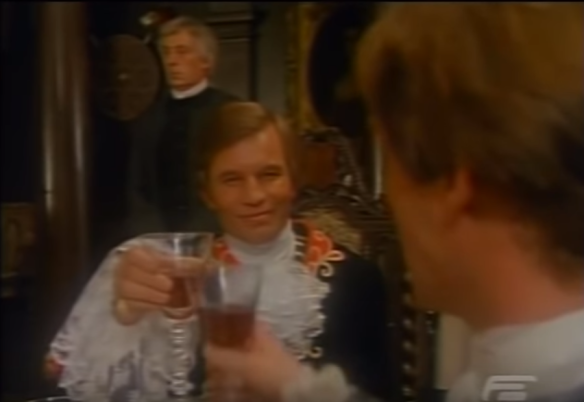
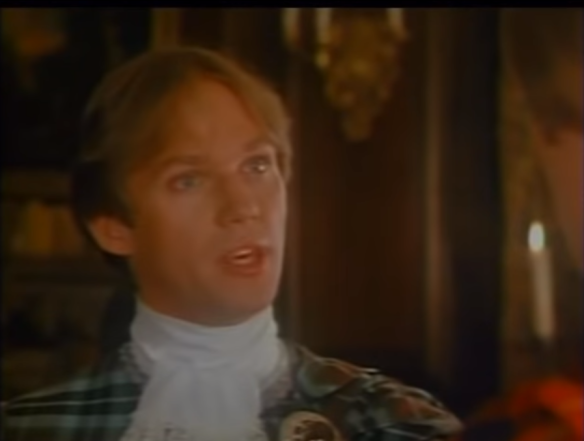
There is a 1950s version with Errol Flynn but I wanted to finish the one I half-saw as a child, so resolutely ignored the earlier production. I might, however, read the Robert Louis Stevenson book on which it is based (published in 1889 – a momentous year for European history). I vaguely remembered the film as the tale of two Scottish brothers in tartan, fighting with swords until my mother shrieked “naughty boy! bedtime! now!” Naturally there is some sword fighting in tartan, but much more. The dynamic character interactions & development remind me of Kubrick’s Barry Lyndon, Michael York’s James Durie even resembling Ryan O’Neal to some degree:
And as with Barry Lyndon the character of Jamie Durie develops from a likeable young rogue to a psychopath who is increasingly, and with some justification, likened to the Devil. He has a particularly slimy smile, the kind women and Leftists find attractive; it is charming but Michael York manages to shade it into a predatory glitter which one could label The Paedo Smirk.
Reminiscent of Dick Tremayne from Twin Peaks, a department store manager, very American with his dead eyes and fixed grin:
and of course the billionaire paedophile (((Jeffrey Epstein))):
York’s performance here is great; the various Jamies plausibly merge, so in retrospect you can see how the charming, energetic young man of the opening is the calculating, vindictive psychopath of the latter years; he was always a monster, and one could see the predatory light in his eyes, from time to time:
His younger brother, the far more staid, prosaic Henry, is played by Richard Thomas, and from the start they demonstrate a natural antagonism and rivalry.
I seem to remember, as a wee young bairn, admiring York’s psychopathic Alpha Jamie, but as a doughty & gouty old shopkeeper my sympathies were quickly drawn more to his younger brother Henry. It’s the kind of film one could watch in the heinous light of Anonymous Conservative’s r/k dichotomy, Jamie as the r-selected reckless impulsive psychopath, the much more prosaic brother Henry as a proto-k. At first, the audience would likely find Henry boring and timorous – even though he volunteers for war – but the genius of the film is, as with Barry Lyndon, the evolution of character.
After Jamie goes to war he becomes a Lyndon-style gambler and thief and vile scoundrel, charismatic for sure, but then I’ve met at least one psychopath who was every bit as mesmerising, every bit as untrustworthy & beshitten of character. And the more conservative, cautious Henry becomes a man as he recognises his responsibilities in his elder brother’s absence.
Jamie’s return – when he needs money (the usual home-coming impulse of such prodigal psychopaths) – spurs both men further into their nature, Jamie becoming a creature of spite & vengeance against his more down-to-earth, essentially sane brother, hating him purely because he isn’t a wastrel; and Henry forced to deeds of violence, very much against the grain of his over-civilised soul, though he’s also too much the opposite of his brother to fully embrace the inner barbarian, too much the stable younger brother to simply kill his nemesis.
There is much to enjoy here, for example an excellent pre-Bond Timothy Dalton as an Irish scoundrel who tries to rob Jamie and ends up partnering with him in deeds of villainy, and who could forget Brian Blessed as the perpetually drunken pirate Captain Teach:
It would make an excellent companion piece to Barry Lyndon. I wanted to include a 1984 Master of Ballantrae trailer but couldn’t find a single one on Youtube, so here’s a not-really-related but great & short video commentary on a great Barry Lyndon scene, by the greatly-bearded Apollonian Germ:
Anyone who enjoyed Lyndon for the script and character would, I hazard, enjoy the 1984 Master of Ballantrae also.
I think I first heard of “the Red Pill” and “being Red-Pilled” about 2012 or later; though I knew it from The Matrix, a film I saw and vaguely liked back in 2001 or so.
The film dates to 1999 but Red Pill took a while to be absorbed by our societal gut:
Late 2012/early 2013 seems to have been a transitional time in the West.
As I have encountered it, Red Pill is used to indicate an unauthorized right-wing realisation, for example that genetics determine IQ or that women don’t think like men. Despite The Matrix being a popular film directed by a pair of trannies, full of anarchist and anti-authoritarian themes, I’ve never come across the term outside of dissident Right circles.
For me, the Red Pill is the removal of one layer of the grand onion. As in the film, you open your eyes and see everything in a different light.
It is not specific to ideology – it is merely the act of realising the truth, in contrast to a consensual illusion.
That perhaps explains why Red Pill is not a Leftie term – the consensus is Left-wing; just as almost all calls for censorship come from the Left, so they find no use for the concept of the Red Pill: for them, the illusion is reality. To challenge the prevailing account is to challenge the Left, because they are the convenient servants of the System.
Even in my early 20s I was essentially a man of the Right, for I preferred Beethoven to Oasis, Oxford to Bradford, Titian to Damien Hirst, as I think do many on the Left – the difference between us, that I followed my aesthetic preferences to their logical conclusion, and the champagne socialists I know advocate for mass immigration, socialist levelling, but choose to live in all-white suburbs and would prefer Rembrandt to a Tracey Emin.
My Red Pill odyssey began later.
With each shedding of the onion skin, I became estranged from my younger self and from those still plugged into the Matrix.
As Morpheus tells Neo:
The Matrix is a system, Neo. That system is our enemy. But when you’re inside, what do you see? Businessmen, teachers, lawyers, carpenters. The very minds of the people we are trying to save. But until we do, these people are a part of that system…and that makes them our enemy. You have to understand, most of these people are not ready to be unplugged. And many of them are so inert, so hopelessly dependent on the system that they will fight to protect it.
The Red Pill severs you from the NPCs. You may as well be the only player-character, everyone you once called a friend now revealed as a computer-controlled figure.
Earlier this week I was talking to a group of German women, mostly late 50s to 70s. They said that women are discriminated against everywhere, then blithely added that most schoolteachers are women. I suggested that women tend to be more interested in people than things; men, vice versa. One of these women, who earns about ten times what I’ve ever made, and is probably more intelligent than me, smirked and shook her head and said that it’s impossible to generalise because there are women who are engineers. I said, patiently, “yes, that’s what I mean, there are individuals but in general -” and she just kept smirking and shaking her head, and then adduced as incontrovertible evidence of her views, that she preferred playing with cars to dolls when she was young.
At this point I gave up and just assumed a polite facial expression.
Another of these smug women said that men are becoming like women now, and that is obviously good.
Almost all the women nodded enthusiastically.
Group X says the world would be better if everyone was identical to Group X, and then they sit there smiling at their own profound insight. And it doesn’t occur to them that they may simply be narcissistic and deluded. In a sense, it is supremely German – for all their cultural suicidal impulse, Germans assume everyone should be like them, and be made so by force if need be. The self-righteousness of German women, their finger-wagging assurance and revolting smugness and idiocy, can be hard to stomach. Arrogance attended by its constant handmaid – ignorance.
I wondered, later, if it would have been possible to offer a counter-argument. Unlikely, since I would have needed to talk without interruptions for about 2 minutes. The error in their reasoning, the inability to understand the difference between the individual and the general, was so great I felt I was dealing with NPCs running on a limited script. If someone with a good university degree, from the pre-degree-inflation years, making a good salary, cannot understand the meaning of “to generalise” (generalisieren in German), what communication is possible? Imagine saying “Spain is hotter than Finland” and a smug German woman shakes her head and then sneers: “No no no. I can tell you, I have been on holiday in Finnland in 2002 and it was 28 grad, and in Spanien at that moment only 26 grad, so you are wrong.”
So you say, “yes, but in general -”
And she says, “it is not possible to generalise. Global warming makes Finnland hot because of Donald Trump.”
So you say, “yes, but the average -”
And she says, “no no no, you cannot generalise. One winter it has been for one day 4 grad in Spanien and 5 grad in Finnland. It stands in Der Spiegel so.”
You are separated from the Blue Pilled NPCs by an insuperable, existential barrier. They may be more intelligent and make more money, be vastly more successful than you, but they cannot understand the difference between the individual and the group, cannot understand the concept of “to generalise” or “on average”. You experience intellectual isolation as the words you were taught to use to communicate fail to penetrate the arrogant ignorance of the terminally Blue Pilled. It is not a question of intelligence here, since two of the other, less intellectual women were on my side in this, and I am myself unintelligent and unsuccessful. It is a question of the Red Pill, of having begun the journey to reality.
In accepting reality, you isolated yourself from the majority of the human race. In a sense, you inhabit a different reality, by your perception. The words no longer mean anything, so “to generalise” for you means “to draw general conclusions from large data sets, regardless of individual difference” and to the Blue Pilled the very same verb means “to say that every single individual conforms to a certain description.”
Black is white and white is black. What can you do except smile politely and pretend to agree?
We can feel the life being squeezed out of us, our humanity filtered or crystallised. Weber termed bureaucracy the ‘iron cage’ – that is true, but the worst of the cage is that we know it as a cage yet have chosen to inhabit it, and that we disbelieve in the possibility of a life outside of the cage.
I was lucky enough to be born & raised before bureaucracy had an iron hold on my homeland, a homeland which is now a semi-Orwellian state of mass surveillance and mass proscription, where almost everything is illegal unless you are a Muslim (in which case everything is permitted). I was therefore greatly affronted by the bureaucracy in my Alma Mater, a decade or so after Charlton, and one of the first lessons of my tedious office jobs was “don’t try to debate the rules, especially when they make no sense.”
Like most relatively sane people, I detest bureaucracy. I felt it strangled all that was human & good in the university I attended, and in my office jobs it seemed an either pointless expenditure of time & energy, or actively contrary to its alleged purpose, e.g. Equality Officers who ensure that any white straight male or Christian is discriminated against.
It is worth noting that the religion chosen by our rulers is one of detailed regulation; for all its crudity and neolithic savagery it is an essentially bureaucratic religion.
There is, in bureaucracy, a ratcheting effect whereby even when we feel the bureaucracy to be needless and dispiriting, we shrink from a reduction thereof. I experienced this myself in one of my many tedious jobs, in a hospital, where medical students called to ask if they could borrow a textbook for an exam – their library having lost theirs. My initial reaction was a 50-50 of “why not?” and “that’s probably against the rules”. I thought about it for 2 or 3 seconds and said “that might be okay, but I need to check.” My manager said they could come and make notes but couldn’t take the books out of the teamroom or photocopy anything, since of course that could leave the hospital open to a lawsuit.
Later, I wondered why I had initially shrunk from granting a perfectly reasonable request – for a couple of medical students, based just across the road, to use our textbooks. But this is the constantly ratcheting effect of bureaucracy, to diminish not merely freedom but the desire & instinct for freedom. It is most likely a natural psychological reaction, that provided a man has structure & stability, he will shrink from any diminution thereof – even if there are clear justifications, the structure cripplingly inhuman.
The human mind requires structure & stability, the Germanic peoples being the most extreme examples in this regard, since Ordnung muß sein. Just as the Bosche would rather live with a destructive, inhuman order than with freedom, so the human mind will very quickly adapt to structure, and resist its removal. This leads to one natural conclusion: the Tower of Babel.
Destruction:
and lest you think this mere mythopoetic speculation, it is good to ponder the EU Parliament and reflect that They certainly built it with this in mind:
Bureaucracy waxes as a sense of the religious/spiritual wanes. When Man denies the gods, all that is left is the manmade, and what could be more tritely manmade than bureaucracy and ugly architecture? The European Union is a project for the utterly manmade world, divorced from that which created Man – it is, like all advanced bureaucracy, Satanic.
The modern Satanic idea, “you are god” says “there is nothing to which you are not subject.” But since every human being is therefore god, that means other human beings can create their own senseless order, and force you to submit to it. Hence, the semi-religious fervour of the true believers in bureaucracy – in Europe, those who regard the European Union as the saviour of mankind, because, well, a bunch of bureaucrats and politicians and bankers, and their bought academics & “journalists” said so, and if you don’t like it you’re a Nazi and should be locked up and your children given to the Religion of Peace.
The Tower card seems extremely negative. Destruction, calamity, loss. We resist the degradation of an accustomed structure, however horrific. And yet, as Chigurh says in No Country For Old Men: “If the rule you followed brought you to this, of what use was the rule?”









 Remainders