the spirit in the machine

Bruce Charlton and William Wildblood have been considering Artificial Intelligence, in particular as a vessel for demonic intelligences. My own feeling is that everything physical has a spiritual (or non-physical but real) counterpart. There are also, I think, spiritual forces, e.g. the idea of a nation, which exist without an exact physical counterpart, but which nonetheless bear influence in the materium. Perhaps the pleasing grain and texture of certain physical objects is to do with this immaterial anchoring, a spiritual underpinning & echo.

So, a pen or a book or wristwatch has a “spirit”. Logically, it seems computers must too; and yet, while I have grown very fond of certain books – the particular physical book, not merely the arrangement of letters therein – I have never felt the slightest attachment to a smartphone, PC, DVD, or CD. When my old copy of Dante’s Inferno literally fell apart through a decade’s reading, I felt sad and would have much preferred to have it repaired than buy another; and when I inevitably bought a replacement, in the exact same edition, I nonetheless felt disappointed – this new book wasn’t mine, not the Inferno I knew and enjoyed. I ended up ripping the old edition’s pages out, and using them as decoration on my office walls, and as wrapping paper for gifts.

I never felt such loyalty to CDs, DVDs, the PC I’m using now, or my smartphone. Even my old dumbphone, which I quite liked, was merely a thing to me. Although I understand little, and like less, of technology, I think everyone feels this way – even the most impassioned Apple geek would, I imagine, be delighted if Apple offered him a brand new replacement for his 6-month-old Mac: he would not think, But this is my computer, I like it, we have a history. No, he would seize the opportunity to get a free replacement.

And so, if computers do have a spirit, it is presumably a cold and frictionless surface, to which human experience and loyalty will not cling. It is denatured and alienating. When a computer goes wrong, it feels, somehow, perverse: at best, an indifferent spirit has decided to stop working; at worst, a malevolent imp has decided to cast its hex upon our evening.

For this reason, I don’t foresee a straight-line trajectory for technology. I am, of course, unusual; but I am often harbinger and stormcrow of catastrophes to come.

TV report: The Young Pope

A surprising pleasure. I didn’t like the idea at first: an American Pope who smokes and shocks the wicked stupid Europeans, it seemed a Nuns on the Run/The Pope Must Die-tier concept and I grimly braced myself for political correctness and grotesque diversity and niggertude.

It begins with Jude Law’s new pope, Lenny Belardo, recoiling from the prospect of giving a public address. Shenanigans ensue as the various cunning Italian cardinals plot to manipulate or depose him. In the background, a child abuse scandal and Belardo’s own emotional problems as an abandoned orphan.

To my pleasure & surprise, the new Pope becomes increasingly badass & traditional, to the point where I wondered how this TV show made it on air – presumably, it was marketed as satire or subversion. The characters are all highly likeable, my favourites being the Cardinal Secretary of State Voiello and of course the Pope himself, who wishes to root out homosexuality and vice.

I’m unsure to what degree the show was intended to subvert and attack traditionalism. Pope Lenny is charismatic, theologically homophobic, chaste, and can work miracles through prayer; but he also doubts the existence of God, and has periodic bouts of Luciferan pride.

The Young Pope

In any case, while it is most likely heretical and unsound, I enjoyed it immensely. Anyone who wants to see visionary surrealism and aggressive smoking in the Vatican would be well advised to give it a go.

blonde

I was visiting a friend over the weekend; he and his wife are both dark-haired Germans, their 3-year-old son is totally blond. It seems that children are often blond and become darker with age, e.g. a 30-year-old English woman I know is now brunette but was Swedishly blonde even in her early 20s.

I recall Juden Peterson talking once of “cuteness”, meaning big eyes and other features which soften the heart of most normal people. Not merely children but young animals (puppies, kittens, etc.) demonstrate the same “cuteness”. If one sees this as a purely evolutionary development – that creatures which don’t look “cute” as young children are more likely to be killed or abandoned – then blondness most likely has an objective quality, and is perceived as more interesting than dark hair for deep-seated biological reasons.

That is, God prefers blondes.

the secret society

Anonymous Conservative maintains there is a parallel society to ours, a secret society of Cabal henchmen and managers. From his own gangstalking experience, he estimates it as a significantly large operation. My guess is, most of those in the s.s. don’t really know what they’ve signed up for, but are ready for action when required. A hint, however, of the magnitude: there are now close to 120,000 sealed indictments in America.

Let’s say that’s 120,000 individuals, who are directly or indirectly in the pay & service of Cabal.

There are officially 327 million people in the US.

327,000,000 divided by 120,000 = 2,725.

Of course, some of these 120,000, assuming they are 120,000 individuals, are not even indirectly Cabal; however, we can also assume that there are many many more Cabal staff who are not on the list (so far). But we can speculate that there are at least 120,000 Cabal employees in the USA.

So, as things currently stand we can estimate that one in about 3000 US residents are Cabal. Assuming a flat distribution, that means if you live in a town of 200,000, about 66 will be Cabal – and, presumably, not tramps or kiosk cashiers, but policemen, judges, public officials; and, of course, journalists.

why I don’t care about organisations

From The Z Man:

The exile, in contrast, denied access to the institutions, will place his trust in ideas.

[…]

This is the difference between the dissident and the dispossessed. The former not only accepts his outsider status, but relishes it. Free from the institutions, he can develop his own mental framework as a genuine alternative to the prevailing orthodoxy. The dissident sees his expulsion as the break, the vital break, from the historical and intellectual timeline. Rather than being carried forward by the momentum of his inheritance, he creates a new vision to replace the old.

The dispossessed, in contrast, are haunted by their expulsion. Who they are is defined by their loss of institutional support. They are the bitter ex-wife or the disgruntled former employee. They stand outside, perhaps shouting criticisms, as their identity is an entirely negative one. They relish every slight. 

I could define myself a a dispossessed dissident to whom no one pays attention; but I was once merely dispossessed. After leaving university with high qualifications, unable to secure PhD funding or a job, consigned to minimum wage drudgery in officeland, I yearned to return to academia even while criticising its gross corruption & ideology. I still enjoy being in universities and similar, allegedly non-profit-making organisations (certain public sector offices, the military, monasteries, etc.) but I realise I was blessed to be cast out of academia. My ideas, such as they are, are free to develop in near total obscurity. Although several people have gloated that my mind would become “stagnant” without their valuable feedback (hectoring, sneers, etc.), I feel better when I write for no one, accountable to no one.

As a far right-winger, I sometimes contemplate our in-fighting and competing organisations with baffled distaste. I don’t care if X is Eastern Orthodox or Catholic or Protestant, or is married to a woman priest, or is gay, or thinks Trump is stupid, or favours socialism or tribal anarchism or cutthroat capitalism – the main thing which interests me: is he on the side of European culture/civilisation and the white race? If not, I can be at best lukewarm. If so, his taxation model or even support of Israel, are of minor interest. I would rather live in a 99% white nation with ruinous economic policies than a “diverse” modern dump with low taxation and thriving businesses. A ruined economy can be rebuilt by the entrepreneur; a multicultural hellhole, alas, calls for the psychopath and his particular art.

The times are so dark, it should be evidently unimportant to which organisation or faction one belongs; but that there is a naturally fissiparous tendency in men, and perhaps some on the Right are already imagining themselves in a position of power, when the dust has settled; and others are simply of a warlike disposition, and will make war on even their own side, even in the heat of it.

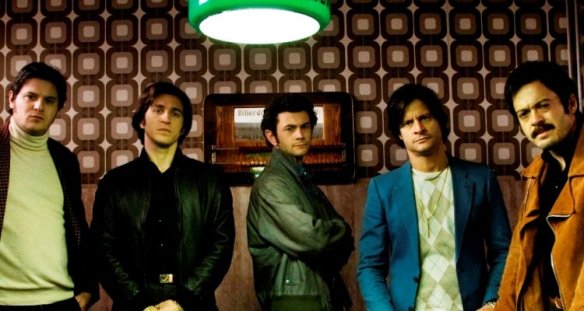
TV report: Romanzo Criminale

An Italian TV drama from 2008-10, based on a true story of some 70s thugs in Rome, I loved it from start to finish, and I normally don’t have much interest in Mafia/crime stories. It is technically proficient, with beautiful visuals, an especially imaginative and well-chosen soundtrack, an almost perfect script, and great acting. The series delineates the rise to power, and later in-fighting & disintegration, of a band of friends in 70s/80s Rome.

The story itself isn’t very interesting (to me) but I loved the character arcs, as some become increasingly grandiose and paranoid, some increasingly introverted and ruthless, some scornful and unpleasant, some kind of pitiful and much put-on by typical Italian wives.

It’s fairly brutal but most of the violence is, by my standards, low-key; the exception is the beating one character endures, which I found a bit grimacerous, but was probably necessary for the story.

Perhaps surprisingly, almost all the characters are quite likeable, I especially enjoyed Freddo (cold & pent-up) and Dandi (beautifully-dressed and increasingly nasty, while somehow remaining mesmerisingly charismatic).

My woman looks, oddly, like a female version of Dandi, with a very similar facial structure and mannerisms, which added a certain piquancy to it all.

If I had to describe it, it’s like Terrence Malick and Scorsese made a TV show together, with input from Michael Mann. There are some indescribably beautiful scenes, e.g. when one of the main characters is gunned down at the end of Season 1, and the gang arrive, one by one, staring at the body in the rain & dark, from the police cordon, as the copper in charge of their case stares, as it were ticking them all off from his list of Wanted photos. It’s a scene of such visual loveliness, I felt the series had gone beyond mere crime drama and become something from The Thin Red Line.

Certainly, one of the best TV shows I’ve ever seen.