A highly worthwhile, fun film which gave me a similar feeling to the most superficial level of Once Upon a Time in Hollywood – a return to the days where America was white, and men were men, even if insufferably so. Bale is great as Ken Miles, a mid-40s Brummie car mechanic and occasional race driver, he even somehow manages to look like the man, and the accent is more (to my ears) authentically Brummie than most of the Peaky Blinders cast.
The antagonistic chemistry between Bale’s driver and Matt Damon’s Carroll Shelby, is the subtle heart; Shelby as a retired driver who has become something of a company man for Ford, but understands the Yeatsian passion of the true driver:
Nor law, nor duty bade me fight,
Nor public man, nor cheering crowds,
A lonely impulse of delight
Drove to this tumult in the clouds
The race scenes are very well-done, Bale as a wiry, wrench-looking part of the car, with the utter focus of the true athlete or creator.
Women probably would find the film baffling, and expostulate, “Why do these stupid men risk their lives for a stupid car!!! Why don’t they have a nice cup of tea in a cat cafe and talk about nice things instead!!!”
A surprisingly great film; I expected a kind of aged Casino, a Scorsese best-of with De Niro, Keitel, Pesci and of course The Rolling Stones’ ‘Gimme Shelter’, but it’s actually a very solid, entertaining work. The film follows De Niro’s Frank Sheeran, a mob enforcer who ends up protecting and then betraying Al Pacino’s Jimmy Hoffa; the last half hour depicting his decline into old age. It’s so quintessentially Scorsese that he even uses de aging CGI to use De Niro, Keitel, and Pesci rather than simply looking around for age-appropriate actors.
I had two criticisms: the 3 and a half hour length could have been easily cut by 20-40 minutes; and De Niro’s de ageing. For some reason, Pacino, Pesci and Keitel look perfect; but De Niro looks deeply & unnervingly strange. He doesn’t look 30-50; he looks like a 70-year-old with adept plastic surgery and cosmetics. The face is unlined but somehow weird, implausibly human; and he moves like an old man, a chubby old man at that, with no energy, no menace, no purpose, as if walking 5 meters is a bit of a challenge. His entire body language is that of a sofa-bound, portly old man’s. No CGI can correct this.
There is, in addition, something on the edge of evil about this De Niro; it’s not merely that his character is a killer – the character himself should be one of Scorsese’s amiable psychopaths. But I found him unsettlingly inhuman. I’m not sure if it’s the CGI or knowing what I think I know about De Niro as a Cabal tool, but watching him is no longer a pleasant experience: it feels evil, he feels evil.
There is however much else to enjoy. Pacino and Pesci look totally natural, Pacino could pass for his 1995 Heat‘s Vincent Hanna, and whereas De Niro looks like a horror movie figure Pacino’s character is very human, a masterpiece of cinema. For the most part, De Niro gives a good but eerily evil performance, from which I recoiled; Pacino’s Jimmy Hoffa is by contrast one of the great figures of cinema, indeed I thought this one of Pacino’s truly great performances, up there with his Michael Corleone. It’s a pity the rest of the film doesn’t rise to Pacino’s peak, but then few films could.
A 2011 legal thriller, very run of the mill stuff – competent, rather pleasing plot & characters, nothing too special except for Matthew McConaughey as the titular lawyer, a cunning, borderline-sleazy operator who defends drug dealing bikers, murderers, etc.
It’s worth watching just for his performance, a precursor to his 2014 Rust Cohle, with very similar mannerisms & a predatory intensity, and an identical “sheeeeit”.
A film in the vein of Rush, with two antagonistic and, in terms of character, contrasting athletes, John McEnroe and Björn Borg. Shia laBeouf and Sverrir Gudnason are both excellent, with a similar hardened, explosive intensity – the difference being that Gudnason’s Borg seems to explode at some almost undetectable depth of the soul, his impassive Pewdiepie-esque face only occasionally and very faintly registering some kind of internal panic or fury. LaBeouf’s McEnroe is a small, nervous ball of anger (McEnroe is noticeably taller in real life, apparently the same height as Borg – 180 cm). They’re both oddly charismatic.
I especially enjoyed, as in Rush, the post-match accidental meeting of the two men (Borg won). They’re waiting in the airport, Borg spots McEnroe from afar and looks uncertain if he should say anything,
McEnroe however sees him
and immediately walks over, so Borg comes out to meet him
and they have a typically masculine conversation:
McEnroe: Congratulations.
Borg: Thank you.
McEnroe: Yeah. Good match.
Borg: Thought you had me.
McEnroe: Almost, yeah.
There is a taciturn ease here. Borg’s girlfriend is in the background, looking unsure as the men chat and then exchange a hug (in real life, they apparently became good friends after the match).
I enjoyed this film, and Rush, because they demonstrate a feature of male relationships – competition and friendship. In the West, competition is often seen as somehow shameful, because someone has to lose. I knew a homosexual Boomer once who used the word “competition” as synonymous with “aggression” and hated all sports because there are winners and losers. An ex-professor at my university, he said that all students should automatically get a 2:1 just for turning up, and if you want to do the exam you then get a 1st, automatically. It’s very modern thinking and would have struck pretty much every human being who has ever lived as evidently childish, impractical, almost insane thinking.
It’s also a very female view of things. It’s not that women aren’t naturally competitive – they clearly are; but whereas for men competition is a means of establishing the (fluid) hierarchy and getting to know the capabilities and weaknesses of your fellows in order to have an ease and friendliness together, for women it’s more about crushing potential foes. For women, competition is aggression and violence. For men, competition is a modulation of friendship – every competitor is a potential friend, because you get to know people through a certain rough play and jostling, and once you know someone you can be friends.
Thus, women often remark on how aggressive men are, not understanding that it’s not really aggression with the intent of destroying or damaging the adversary; it’s more a testing of boundaries, and what women often mistake for abuse is merely a friendly jest.
Women are inherently averse to risk – there is probably a link between testosterone and the adrenaline release of risk-taking. Thus, women are only confrontational and competitive when they are sure they will win. Women do not understand the concept of the heroic defeat (Thermopylae, The Battle of Maldon, etc.) because a woman would only fight if she was absolutely assured of victory to begin with – and then she would be relentless and vicious. A man would fight to preserve his standing, his sense of himself as a man capable of projecting force in a world of forces & wills – and a man would be more likely to accept a defeated foe’s surrender with good grace. A women would execute or at least enslave the white-flag-waving enemy, because for a woman the whole point of competition is to subjugate and destroy.
As is often the way, fear leads to misprision and violence; strength makes for understanding and peace.
A good, almost great, film. The opening, with Cruise’s Nathan Algren as an alcoholic soldier trotted out on stage to sell Winchester rifles with tales of derring-do (actually, slaughtering villages of Amerigooks), is superb; and I greatly enjoyed the middle section, with Algren captured and slowly civilized by the samurai. The last section, the giant battle and closing, falls flat for me – it’s technically very well done but a little unimaginative, predictable.
All of the acting is splendid. Ken Watanabe is particularly good, bearing a Chow Yun-Fat esque charisma and bald head and lengthy sword.
The film was successful, interesting as it romanticises tradition and masculinity and the warrior code – all the things despised and reviled by the chaimstream media and Hollywood and our rulers. I especially enjoyed the respect for death, the sense that a good death makes for a good life.
A pleasing, light-hearted film. It’s hard to find comedies that make this old dog so much as smile, let alone laugh. Spy, a satire on, well, spy films, is directed by Paul Feig, who was responsible for the feminist abortion that was 2016’s “woke” Ghostbusters. Watching Spy in this light, it is easy to see the feminist agenda, though it is pleasingly free of paedophilia, Satanism, anti-Trump rants, and heroic black men who make great fathers and are just so much wiser and better than the White Devil.
I enjoyed the film enormously. The central character, a fat bumbling but somehow lethally-effective CIA desk agent, is amusing and unthreatening. I imagine, were the film made a couple of years later, she would have gone off on anti-Trump rants every 30 seconds, but this was a more innocent age and so she is a kind of box wine cat lady auntie. The film is so nourishing for those in a bleak situation because of the love of character – every character is lovable, fun, my favourites being the Italian agent Aldo
and the Statham-esque Jason Statham.
Curiously, both characters are in a sense playing themselves – Aldo is the Italian cliche, loud, lecherous, fast, but as I was watching the film I thought “Italians are actually like this”. As Geoff Dyer wrote, somewhere, the favourite Italian pastime is to act like an Italian. And Statham is somehow both over the top and precisely himself – almost every Statham film features the man as the hard-headed, omni-competent, profane Sarf London brawler (though he’s actually from the Norf):
I’ve always liked Statham. His performances are so reliably insane
that I felt he must be smiling at himself and his image throughout. He has that very English intelligence, which learns to mask itself – in his case, his mask is Jason Statham. He excels here, my favourite being the scene where he appears in a rather nice suit and Melissa McCarthy’s cat lady says ” where did you get that suit?” and he snaps back: “I fucking made it, didn’t I?”
And so, you can have a film written & directed by someone who looks like this:
which is actually enjoyable for old dog fascists, somehow.
A film I half-saw in my childhood, my mother cruelly refusing to let me stay up after my bedtime; my last memory was the sword fight between the two Durie brothers, until earlier this week when, as an old man, I was spontaneously moved to look it up & satisfy my cinematic curiosity. The whole thing is on Youtube, quite low quality but no alternative (paid or unpaid). It’s a surprisingly sound film, and even though I generally dislike films over 2 hours (it’s 150 minutes) it fairly zipped by with a lean, purposeful script and great acting, the filmic girth handled with far greater aplomb than as is the case with most modern productions.
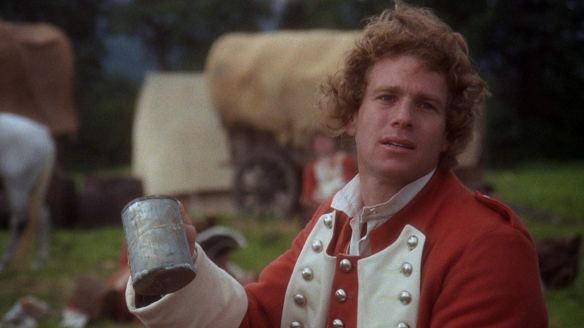
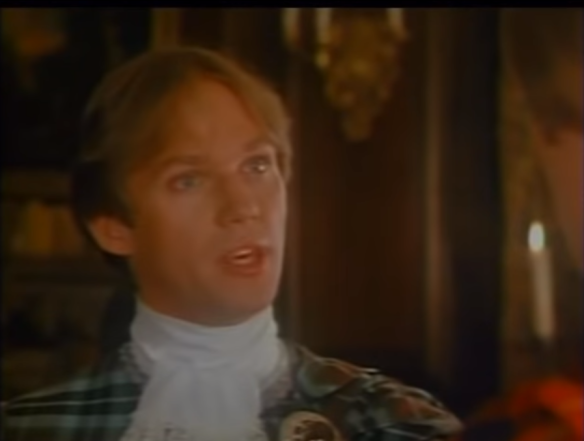
There is a 1950s version with Errol Flynn but I wanted to finish the one I half-saw as a child, so resolutely ignored the earlier production. I might, however, read the Robert Louis Stevenson book on which it is based (published in 1889 – a momentous year for European history). I vaguely remembered the film as the tale of two Scottish brothers in tartan, fighting with swords until my mother shrieked “naughty boy! bedtime! now!” Naturally there is some sword fighting in tartan, but much more. The dynamic character interactions & development remind me of Kubrick’s Barry Lyndon, Michael York’s James Durie even resembling Ryan O’Neal to some degree:
And as with Barry Lyndon the character of Jamie Durie develops from a likeable young rogue to a psychopath who is increasingly, and with some justification, likened to the Devil. He has a particularly slimy smile, the kind women and Leftists find attractive; it is charming but Michael York manages to shade it into a predatory glitter which one could label The Paedo Smirk.
Reminiscent of Dick Tremayne from Twin Peaks, a department store manager, very American with his dead eyes and fixed grin:
and of course the billionaire paedophile (((Jeffrey Epstein))):
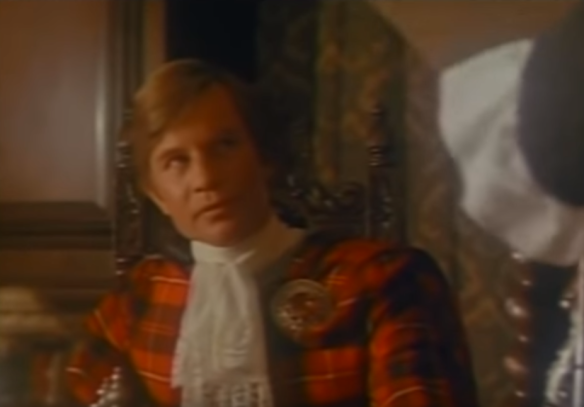
York’s performance here is great; the various Jamies plausibly merge, so in retrospect you can see how the charming, energetic young man of the opening is the calculating, vindictive psychopath of the latter years; he was always a monster, and one could see the predatory light in his eyes, from time to time:
His younger brother, the far more staid, prosaic Henry, is played by Richard Thomas, and from the start they demonstrate a natural antagonism and rivalry.
I seem to remember, as a wee young bairn, admiring York’s psychopathic Alpha Jamie, but as a doughty & gouty old shopkeeper my sympathies were quickly drawn more to his younger brother Henry. It’s the kind of film one could watch in the heinous light of Anonymous Conservative’s r/k dichotomy, Jamie as the r-selected reckless impulsive psychopath, the much more prosaic brother Henry as a proto-k. At first, the audience would likely find Henry boring and timorous – even though he volunteers for war – but the genius of the film is, as with Barry Lyndon, the evolution of character.
After Jamie goes to war he becomes a Lyndon-style gambler and thief and vile scoundrel, charismatic for sure, but then I’ve met at least one psychopath who was every bit as mesmerising, every bit as untrustworthy & beshitten of character. And the more conservative, cautious Henry becomes a man as he recognises his responsibilities in his elder brother’s absence.
Jamie’s return – when he needs money (the usual home-coming impulse of such prodigal psychopaths) – spurs both men further into their nature, Jamie becoming a creature of spite & vengeance against his more down-to-earth, essentially sane brother, hating him purely because he isn’t a wastrel; and Henry forced to deeds of violence, very much against the grain of his over-civilised soul, though he’s also too much the opposite of his brother to fully embrace the inner barbarian, too much the stable younger brother to simply kill his nemesis.
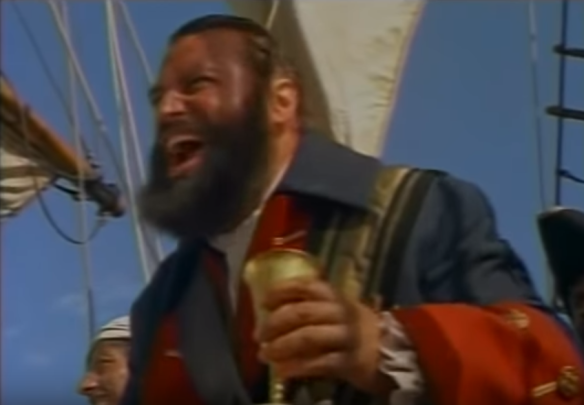
There is much to enjoy here, for example an excellent pre-Bond Timothy Dalton as an Irish scoundrel who tries to rob Jamie and ends up partnering with him in deeds of villainy, and who could forget Brian Blessed as the perpetually drunken pirate Captain Teach:
It would make an excellent companion piece to Barry Lyndon. I wanted to include a 1984 Master of Ballantrae trailer but couldn’t find a single one on Youtube, so here’s a not-really-related but great & short video commentary on a great Barry Lyndon scene, by the greatly-bearded Apollonian Germ:
Anyone who enjoyed Lyndon for the script and character would, I hazard, enjoy the 1984 Master of Ballantrae also.
I watched Lethal Weapon for the 30th time last week. It never fails to satisfy. It has competent direction from Richard Donner, a first-class script from Shane Black, and the ever-superb Mel Gibson and Danny Glover as the leads, with Gary Busey as the villainous Mister Joshua – and quite a few un-PC fag jokes and racial slurs, not to mention meritorious violence executed with real relish and venom.
Previous action films were of the Commando variety – infinite ammo magazines, all hand-to-hand reduced to wild haymakers between hugely-muscled men with tiny eyes. Lethal Weapon demonstrates Shane Black’s attention to minutiae, pragmatic detail, methodology. Thus, Riggs’ and Murtaugh’s second scene together,
they walk through the police underground car park and compare handguns, Riggs’ eyes flicker down and he asks: “What you got there?” – the interest of a professional.
Riggs is the centrepiece of this film, a suicidal man at his prime of life – he exists in a state of violent equilibrium, his lust for his own death projected out onto the world with equal intensity; kept just about within check with a certain wry humour at himself. Although Lethal Weapon is basically an action film, the determining subtext is that of suicide – the entire film is structured around Riggs’ desire to die. Murtaugh, the family man surrounded by life, instinctively recoils from this destructive aura; Riggs’ violence towards the bad guys is merely a modulation of the suicidal impulse – if he was not fighting them, he would kill himself (Nietzsche: Unter friedlichen Umständen fällt der kriegerische Mensch über sich selber her, that is, In times of peace he warrior makes war on himself). It is only through defeating darker versions of himself (ex-Nam mercs), the aptly-named Shadow Company, his own shadow self, that he comes to some kind of peace with himself.
The final ruck with Mr Joshua is, I think, the earliest example of fairly realistic hand-to-hand combat in cinema – lots of grappling and use of makeshift weaponry.
Los Angeles looks horrible to a European like me, a sprawling desolation of hookers & crime and straight roads to more hookers & crime, which makes Riggs’ craziness & rage perfectly reasonable.
The achievement of Lethal Weapon, like other action classics (e.g. Predator) is to do with the vital subtext. On the one hand it is a pure action film; on the other, it’s Trois Couleurs Bleu – a redemption tale of suffering, self-destruction, and arduous rebuilding and connection.
You could see Lethal Weapon as the tale of Juliet Binoche’s character Julie, having survived a car crash that took out her family, rediscovering purpose through deeds of violence against the scum of the Parisian banlieue, finally ending in a showdown against Irene Jacob from Trois Couleurs Rouge
where they roll around in a kind of mud pit, ripping each other’s clothes off as Danny Glover watches in a blood-stained Die Hard-style wifebeater vest.






 Remainders