A kind of spin-off novelisation of the 80s HTV show Robin of Sherwood, written by Richard Carpenter, Robin May, and Anthony Horowitz. The book is okay, evidently hastily-written with minimal characterisation or attention to the usual narrative niceties, but has many enjoyable moments. I wouldn’t advise anyone to read it if they haven’t seen the HTV show, indeed it doesn’t add much to the original series save for some occasional well-written passages. Here’s a trailer for the TV show:
It’s one of these 70s/80s TV gems, low budget but astonishingly good, with a psychotic Will Scarlett played by of course Ray Winstone, and an excellent Sheriff of Nottingham. The death of the first and best Robin is well-described in the novelisation:
The men-at-arms were murderously close now, just a few yards short of the first boulders as Robin set his last arrow on the string. The Sheriff was nowhere to be seen – hiding behind his men while they brought down the outlaw. The great bow bent and sprang, sending the arrow flying high over the forest in a salute to all that had been. In the last moments that were left to him, Robin unstrung his bow and broke it on his knee. Then the soldiers charged forward and he was lost from sight as swords flashed down, glinting in the sun.
TV docudrama about the 1986 nuclear plant explosion. Morgoth made a great video about it here:
The series opens just after the initial explosion, with a group of largely bewildered technicians in the control room, their chainsmoking manager Dyatlov alternately blaming them for everything and snapping that it’s just a minor leak (when in fact the core reactor has exploded). The action then moves higher up the chain of bureaucracy, all the way (briefly) to Gorbachov, and then comes to focus on Valery Legasov, Deputy Director of the Kurchatov Institute of Atomic Energy
and Boris Shcherbina, vice-chairman of the Council of Ministers
It is quite superb.
I enjoyed Chernobyl as study of responsibility through management. The initial manager, Dyatlov, is an appalling, stupid, venomous human being and as such typical of low-level team leaders in every organisation; I had several (female) managers like Dyatlov when I did office work: spiteful ignorant creatures who issue stupid orders and then, as here with Dyatlov, scream, “What did you do?” when things go wrong. I wouldn’t even label him a typical Soviet, he is simply what you get in every organisation if you incentivise quotas over reality. The whole series exemplifies many of Bruce Charlton’s critiques of our Ahrimanic age.
Shcherbina begins as a much higher-level version of Dyatlov, interested only in a skilful cover-up. However, as he is drawn into the horror – and the opening episode has an overwhelming, Cthulhu-esque ambience to it, as if something not merely harmful but actively evil has been unleashed – Shcherbina becomes a fully human man, a man indeed. The crucial point is when hundreds of miners are basically sent to their deaths to tunnel under the reactor, and the leader asks Shcherbina if his men will be taken care of; the correct Soviet/managerial response would be to smile and assure them that everything will be fine. Earlier in the show, the Minister of Coal had arrived in a nice blue suit to send the workers to Chernobyl:
They agree to the job and pat him on the shoulder and face with their coal-smeared hands; as one says:
“Now you look like the Minister of Coal”.
There is a powerful implied contrast between the blue-suited fop and the grimy workers (the latter will later strip naked to toil in the hot tunnel); a contrast between the born bureaucrat, and the men who work.
So when, some days later, the leader asks Shcherbina if his men will be taken care of, and Shcherbina says simply, honestly, “I don’t know”, it is a mark of Shcherbina’s own turning away from lies and “management”; a turning towards work and honesty. It’s a small moment, but Legasov gives him a startled glance, understanding the rarity of such clarity, of Gerontion’s “I would meet you upon this honestly”.
There are other ghastly managers. I especially loathed Viktor Bryukhanov, expertly played by Con O’Neill. He strongly reminded me of an apple polisher I knew at university, 20 years ago, a man who seemed to have been created in a managerial seminar. My apple polisher acquaintance was a thoroughly dishonest individual; he did not indulge in petty lies but rather angled his cunning, cowardly, mendacious self to reflect whatever pose would best serve his interests. Bryukhanov is just such a gloating, self-satisfied bureaucrat, a man thoroughly at home with lies and manipulation – indeed, he would despise the miners as naive simpletons, and be baffled and contemptuous of Shcherbina’s personal redemption; for a man like Bryukhanov, lies & manipulation are merely management tools.
You could view Chernobyl as a show about men in all their varieties of humanity & inhumanity: the life-shredding radiation unleashed by the uncaring, stupid Dyatlov; only contained through the enormous sacrifice of real workers; all of the credit, naturally, being taken by the management, by just the kinds of apple polishers who created the disaster through their embrace of unreality, their refusal of the real and the human.
Season 2 of Paolo Sorrentino’s papal drama, Season 1 being The Young Pope. I was pleasantly surprised at the unpozzed and uncucked Young Pope, so naturally assumed The New Pope would savagely undo all that and revel in degeneracy and filth.
At the close of Season 1, Jude Law’s righteous Pius XIII falls into a coma; Season 2 begins with the decision to elect the meek Don Tomasso Viglietti – Pius XIII’s humble confessor from Season 1 – as the new Pope; he chooses to be known as Francis the Second, and in a horrifying moment the audience realises he looks exactly like Bergoglio.
– the same look of inane, mouse-like niceness, laid over a profound, difficult nastiness.
It is the nastiness of the loser who is suddenly in the winner’s seat, with a winner’s ability to take revenge. His only mode of power is niceness, so he exercises it with ruthless, long pent-up resentment. He unleashes Franciscans, as the Catholic equivalent of Bolsheviks, to destroy the Vatican from within, confiscating gold and jewellery, freezing bank accounts, admitting “refugees” to the Vatican – for unlike the Cabal puppet Bergoglio, Francis II is a simple idiot and decides to open the Vatican to the hordes; except that the hordes are presented as the media and the affluent white liberal elite imagine them – all women and children and handsome, meek young men who are ready to sexually service menopausal cat ladies and nuns. This was the first point at which I winced, but it probably would have been too Red Pilled to have shown the “refugees” as they truly are:
Francis II is swiftly disposed of, and his replacement is Sir John Brannox, wonderfully played by the wonderfully-attired John Malkovich.
He is a curious character: indolent, vain, passive, largely removed from concerns both worldly and divine; it is as if he is so self-absorbed, so self-centred that his vast estates & wealth mean nothing to him; no more than does God or religion. He comes across as a man for whom God is a bit-part player in the grand drama of Sir John Brannox and his guilt and monumental emotional difficulties.
Brannox advocates “the middle way”, a kind of cuckish non-extremism, which basically means “don’t go too far in any direction.” That is to say, it doesn’t mean anything.
Towards the end of the season, Jude Law’s Pius XIII awakes from his coma. He is a welcome presence, as if a Medieval or Renaissance pope were to appear in the present day. I wasn’t entirely happy with the remaining episodes, which felt to me not wholly clear in intent or execution, but there were many fine moments as the “emeritus Pope” interacts with the enthroned Brannox.
I viewed the series as a study of personality and power. All three popes have different understandings of what it is to wield power. Francis II is a materialist like all Marxists, the Franciscans here being akin to various sects (Fra Dolcino, etc.) – in modern terms he is, like Bergoglio, a Marxist who hates not merely Papal corruption and wealth, but Western civilisation as a whole. His understanding of power is wholly negative: he wishes to destroy, to break down. He views wealth as inherently bad, and wishes to disperse the Vatican’s wealth, not for the benefit of others (since having more money would merely corrupt them) but to ameliorate the original sin of having anything at all; the original sin of existence. For such people, the point of “charity” isn’t to improve the lives of the recipients, but simply to take money away from the rich – they would just as happily burn the money. At its extreme, in the Soviet Union, the triumph of the Left is the triumph of death; life & existence are an affront to the absolute equality of nothingness, the true workers’ paradise of non-being.
Francis II has a very Bergoglian/Blairite love of attention, the approval of the affluent liberal elites. There is nothing remotely religious to Francis II; he is a nihilist and narcissist who wishes to revenge himself upon all the fancy Cardinals, the fancy world which kept him down. Were he to meet God, he would try to dethrone Him.
Brannox’s power is very different; it is the power of detachment, of distance, of indifference. He only cares about his self, his appearance; but it is not your standard narcissism – he doesn’t so much care how he appears to others, as how he appears to himself.
This is a man who spends hours at the mirror every morning, for his own satisfaction. The approval of others is secondary, since everyone outside of his own internal melodrama of self must be, at best, of spectral heft.
His non-action is itself a kind of power; he most wavers when he attempts to act, to impress his will (such as it is) upon others. The Brannox “middle way” is more the absence of action, the absence of decision.
Jude Law’s Pius XIII is as startlingly strange as ever. His power is spiritual. God is as real for him as cosmetics and publicity are for Brannox and Francis.
He is much as I understand pre-Modern Popes and indeed many rich/powerful men to have been – simultaneously spiritual, with a magical/superstitious understanding of reality; and worldly and material. He transcends the materialism of Francis II, and the vanity of Brannox. His worldly luxuriance – insisting on being borne into chambers in a ceremonial throne – is not the mirror image of Francis II’s Marxism; it is rather that, for the pre-Modern, everything exists simultaneously, so there was no felt contradiction between the worldly and the spiritual; indeed, spiritual power should be attended by wealth and splendour.
Pius XIII gives a sense of such overwhelming spiritual force that the jewels and magnificence seem somehow irrelevant, as if he could – and he does – step away from them without loss.
My only critique here is that his character is not consistently presented, so he is at times authoritative & puissant, then unsure and human; with no overriding identity to unify the two. It would have been interesting to explore Pius XIII as a man of power who is bereft, unable to sway God, stripped of his titles. For spiritual/magical power is often so – as if it must inconsistently operate in this world, if it is to operate at all.
Tubbs is sitting in a car in America, on a stake-out. Some gangbangers knock on his window, because this is America. Sheeeit, one of these cats got a switchblade. Not to be outdone, Tubbs pulls a sawn-off shotgun. Gangbangers retreat.
Crime boss emerges from house. Were I Tubbs, I would assume the gangbangers were running surveillance for crime boss.
Cut to nightclub. Tubbs pays negro waiter to spill drink on crime boss. I actually thought the waiter was Tubbs until I saw them in the same shot. Tubbs looks more mulatto than 100% negroid, probably got that 5 – 10% IQ boost because his grandmother laid with the white devil. He has a sensitive, violent look – classic Michael Mann protagonigger, I like him already.
Crime boss goes to toilet. Tubbs follows. Fight with bodyguards.
Boss escapes. Tubbs left impotent, helpless, unable to do his job because he is stupid.
Cue Miami Vice theme music.
Cut to Don Johnson with a paedo moustache, watching a negro dance on the corner. The guy from NYPD Blue appears and chats with Don; he doesn’t make enough money, says no woman of his should have to work, he wants to take his wife or whatever out for a romantic evening – right there, you know he’s going to die. Cut to the guy with some sleazy mofo talking about how he wants to sponsor a child or something.
Sleazy mofo takes nice NYPD guy to car. Car explodes. Both die.
Don Johnson visits ex-wife. She busts his balls. He explains his partner died. She busts his balls even more because she is a woman.
Well-dressed negro walks down street, gets in car. Car doesn’t have a roof for some reason. Johnson exploits this vulnerability to jump in the car, grab the negro’s fried chicken and throw it into the back. Johnson is wearing an incongruous peach jacket.
Some kind of drug deal, Tubbs and Johnson are both masquerading as drug dealers; they meet, neither presumably knowing the other is a cop. Local police appear and ruin everything. Tubbs steals Johnson’s boat. Johnson steals a car and is in hot pursuit, to the Miami Vice theme tune.
Johnson jumps into the boat and thumps Tubbs. Tubbs reveals he is a cop.
Johnson unhappy. Amusing line as he expostulates to his superior:
Two weeks! Two weeks of legwork I put in on this bust, and three-fourths of the dealers turn out to be cops! Me, Scottie Wheeler and Dr Voodoo here putting in a surprise guest appearance direct from Fun City! […] My badge says Miami but lately it’s looking a lot like Disney World!
Tubbs wakes Johnson up on his boat. Because Johnson lives on a boat like Duncan McLeod. Johnson, as a white man, does not appreciate a negro in the morning and punches Tubbs, then feels abashed and apologises. Tubbs punches him back: “couldn’t let you handle all that bad karma on your own.”
Tubbs does into the boat to get ice for the bruise, is chased out by an alligator called Elvis. Johnson chuckles, revelling in his white supremacy for only the white man can master the gator: “don’t mind him Elvis, he’s from New York.”
Romantic interlude. Crockett woos some woman thusly:
Maybe I’m getting too old for this line of work. Scraping by on four hours of sleep a day. Living undercover for weeks at a time. Dealer this week, outlaw biker the next. It’s Tuesday? I must be working drugs. Hell on the old nervous system, I’ll tell you.
Classic 80s burnt-out cop dialogue, woman helplessly spreads her legs for the Crockett dong.
Tubbs revealed to be brother of Tubbs, on a vengeance mission against a greaser Cartel boss. Complicated. Crockett unhappy at the news, throws an American football about his own boat, probably breaking his own possessions.
Tubbs in an alleyway for some reason, a tranny appears and tries to shoot him but Crockett appears in a black Ferrari and tranny-assassin gets shot by Tubbs. Justice.
Crockett tracks down the corrupt cop who led the tranny-assassin onto Tubbs. The corrupt cop is a jovial Irishman who took a bullet for Crockett and seemed, thus, beyond reproach. However, like all Irish, he is untrustworthy and criminal. Crockett ends up trying to strangle him to death in his black Ferrari. Soulful scene as Crockett realises you can’t trust anyone, that in this Mannly world every Mann must stand alone and die alone. Just as Hamlet, after his mother married Claudius, begins to question every human relationship he ever took for granted, every truth he assumed, every value, so here – Crockett thinks, “if this guy was corrupt, who can I trust?”
Cut to Phil Collins’ ‘In The Air Tonight’ as Crockett and Tubbs drive a Ferrari down a dark road.
Crockett, heading down his own dark examination, calls his ex-wife:
“I need to know something, Caroline. The way we used to be together…I don’t mean lately, but before. It was real…wasn’t it?”
Just as Hamlet questions if Ophelia ever loved him, if his mother ever loved his father, if anything he knew was true, so here.
Big shoot out. Crockett & Tubbs deal death out with wanton abandon. Tubbs corners the greaser who killed his brother, is about to execute him when the white man appears as the voice of reason: “Tubbs. Not like this.”
A surprising pleasure. I didn’t like the idea at first: an American Pope who smokes and shocks the wicked stupid Europeans, it seemed a Nuns on the Run/The Pope Must Die-tier concept and I grimly braced myself for political correctness and grotesque diversity and niggertude.
It begins with Jude Law’s new pope, Lenny Belardo, recoiling from the prospect of giving a public address. Shenanigans ensue as the various cunning Italian cardinals plot to manipulate or depose him. In the background, a child abuse scandal and Belardo’s own emotional problems as an abandoned orphan.
To my pleasure & surprise, the new Pope becomes increasingly badass & traditional, to the point where I wondered how this TV show made it on air – presumably, it was marketed as satire or subversion. The characters are all highly likeable, my favourites being the Cardinal Secretary of State Voiello and of course the Pope himself, who wishes to root out homosexuality and vice.
I’m unsure to what degree the show was intended to subvert and attack traditionalism. Pope Lenny is charismatic, theologically homophobic, chaste, and can work miracles through prayer; but he also doubts the existence of God, and has periodic bouts of Luciferan pride.
In any case, while it is most likely heretical and unsound, I enjoyed it immensely. Anyone who wants to see visionary surrealism and aggressive smoking in the Vatican would be well advised to give it a go.
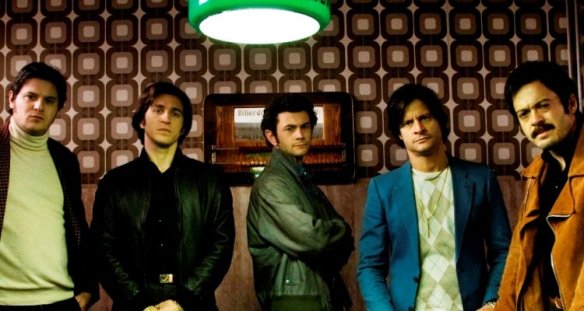
An Italian TV drama from 2008-10, based on a true story of some 70s thugs in Rome, I loved it from start to finish, and I normally don’t have much interest in Mafia/crime stories. It is technically proficient, with beautiful visuals, an especially imaginative and well-chosen soundtrack, an almost perfect script, and great acting. The series delineates the rise to power, and later in-fighting & disintegration, of a band of friends in 70s/80s Rome.
The story itself isn’t very interesting (to me) but I loved the character arcs, as some become increasingly grandiose and paranoid, some increasingly introverted and ruthless, some scornful and unpleasant, some kind of pitiful and much put-on by typical Italian wives.
It’s fairly brutal but most of the violence is, by my standards, low-key; the exception is the beating one character endures, which I found a bit grimacerous, but was probably necessary for the story.
Perhaps surprisingly, almost all the characters are quite likeable, I especially enjoyed Freddo (cold & pent-up) and Dandi (beautifully-dressed and increasingly nasty, while somehow remaining mesmerisingly charismatic).
My woman looks, oddly, like a female version of Dandi, with a very similar facial structure and mannerisms, which added a certain piquancy to it all.
If I had to describe it, it’s like Terrence Malick and Scorsese made a TV show together, with input from Michael Mann. There are some indescribably beautiful scenes, e.g. when one of the main characters is gunned down at the end of Season 1, and the gang arrive, one by one, staring at the body in the rain & dark, from the police cordon, as the copper in charge of their case stares, as it were ticking them all off from his list of Wanted photos. It’s a scene of such visual loveliness, I felt the series had gone beyond mere crime drama and become something from The Thin Red Line.
Certainly, one of the best TV shows I’ve ever seen.
I just finished Season 1 of Person of Interest, a kind of paranoid espionage/conspiracy theory action show. It sounds a bit dodgy but stars Jim Caviezel,
known to the initiated merely as Witt, and was created by Jonathan Nolan, so it’s actually surprisingly good. I found it far preferable to the similarly-themed Burn Notice, mostly because of tone and casting – Burn Notice opts for a jokey Hawaiian beach shorts atmosphere, I don’t really like Jeffrey Donovan as the lead (though he’s great, and greatly-moustachoied in Sicario), and I loathed Gabrielle Anwar as the scrawny, snide “love interest”.
The only actor I didn’t like in Person of Interest was Taraji P. Henson as the obligatory “minority” sidekick – she’s a good enough actor but unfortunately the role very often calls for her to look competent and intelligent and her vibe is more sassy black 85 IQ momma who don’t take no shit from no one and can’t read. When she’s supposed to be looking smart and analytical she just looks suspicious and bewildered, like her fried chicken just disappeared and she don’t know if Tyrone or Jamarkus done took it along with the watermelon and her credit card.
I found it a little amusing as I knew a woman of limited intelligence who tried to look smart & discerning by narrowing her eyes and pursing her lips, quite a clever mimicry but too greatly at odds with her obviously limited cognitive capacity. However, Henson grew on me as the season progressed, I think finding her feet in the role and not trying to look smarter than anyone would find plausible.
The show’s premise is quite good: a machine/software has been developed which throws up lists of people likely to be murdered, the inventor enlists Caviezel’s ex-military character to protect the potential victims. They work in the shadows and so have to avoid police and federal authorities. The basic plot device is a bit like the 90s show Quantum Leap, but as the show progresses it becomes meta-, a lot of the plot revolving around the two heroes’ attempts to avoid being detected by interested parties.
So far I’ve found it extremely rewarding; and as one might expect, given I encountered it via Anonymous Conservative, it is voller Wirklichkeiten, full of realities.




 Remainders